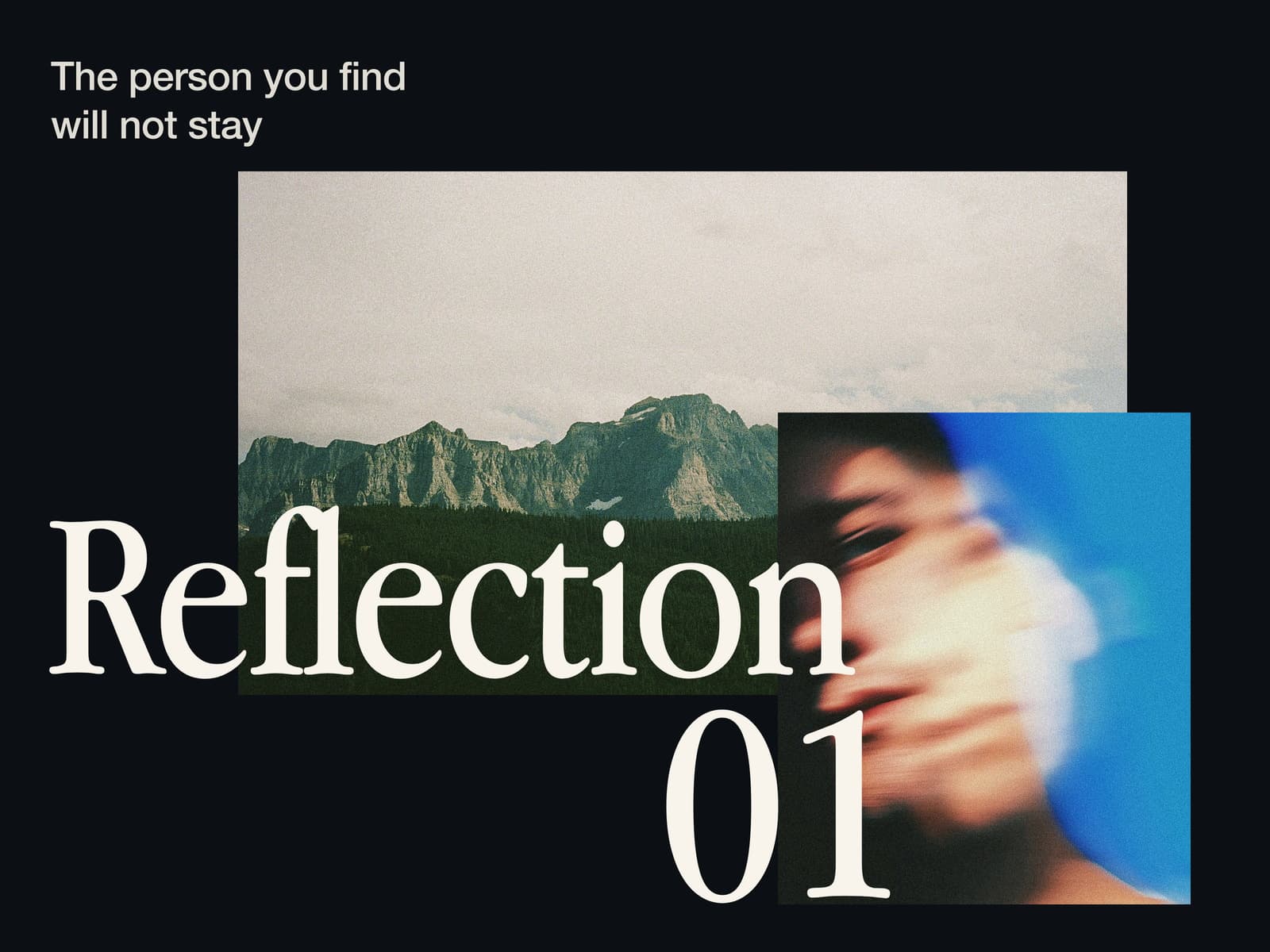
The person you find will not stay
On identity, change, and why finding yourself might be the wrong idea.
During a podcast conversation with Viktor that has not been released yet, I brought up a line from Friedrich Schiller's Philosophical Letters:
Reason has its epochs, its destinies, like the heart.
Schiller was not writing directly about identity.
He was writing about reason, convictions, and the way our thinking passes through different periods.
Still, the line stayed with me.
If our reason has its own eras, and the things we believe have their own history, why do we speak about the self as though it is finished?
People constantly talk about finding themselves.
The phrase suggests that somewhere underneath expectations, work, relationships, fear, and social pressure, there is a final version of you waiting to be uncovered.
Once you find it, you are done.
You know who you are.
I do not think it works like that.
People often say they have found their true self after making a large change.
They leave a job. Move somewhere new. End a relationship. Become religious. Reject religion. Choose a lifestyle that looks unusual from the outside.
Maybe that new life genuinely feels more honest.
Maybe it is closer to what they want at that point in time.
But why would that make it final?
An unconventional version of yourself is not automatically more authentic than a conventional one.
New does not always mean true.
Different does not always mean permanent.
The fact that a version of you feels honest today does not mean it will still feel honest five years from now.
There may be a basic structure underneath everything.
Certain values, tendencies, needs, and parts of your temperament may remain relatively stable.
But a structure is not the same thing as a finished person.
We are constantly being shaped by what happens around us.
By the people we meet.
By work.
By success and failure.
By responsibility.
By grief.
By the things we choose and the things we never chose but still have to deal with.
Some years barely seem to change us.
Life feels almost repetitive. Our values appear stable. The person we are at the end of the year looks similar to the person who entered it.
Other years move much faster.
A few events can change what we value, what we fear, what we tolerate, and what we expect from life.
Sometimes the change is fundamental.
Sometimes it is almost invisible.
But even small changes affect what comes next.
One experience changes a decision. That decision creates a different relationship, opportunity, problem, or environment. That new situation then changes another decision.
This is path dependence on a personal level.
What happens to us does not completely determine who we become.
But it changes the roads available from that point forward.
Psychologists sometimes describe identity as a developing narrative. We take memories, decisions, relationships, and beliefs and connect them into a story that explains who we are.
That story gives us a sense of continuity.
It allows the person we were ten years ago and the person we are today to feel like the same human being.
But the story is constantly being edited.
New experiences change how we understand older ones.
Something that once felt like failure may later look like a turning point.
A belief that once defined us may eventually seem naive.
A version of ourselves that once felt permanent may become difficult to recognise.
Maybe this is why the idea of a fixed identity is so attractive.
It creates comfort.
Believing that you are a particular kind of person makes the future feel more predictable. It gives your choices a framework. It makes your existence easier to explain.
The idea that your current self is temporary is less comforting.
It means that the person you are working so hard to understand may eventually change again.
It means that some of your current beliefs will probably look incomplete later.
It means you cannot fully know which experiences will reshape you next.
But maybe change does not make the self less real.
Maybe being temporary does not make something false.
The person you are today is real.
They are just not final.
I still think there is value in trying to understand yourself.
But maybe “finding yourself” is the wrong goal.
Finding suggests an ending.
Understanding allows movement.
Maybe the most honest answer to “Who are you?” is not a fixed statement.
Maybe it is:
This is who I am, for now.
Further reading
- Philosophical Letters, Friedrich Schiller, 1786, full text at Project Gutenberg
- The Development of Autobiographical Memory, Robyn Fivush, Annual Review of Psychology, 2011
- Adolescents' Identity Formation: Linking the Narrative and the Dual-Cycle Approach, van Doeselaar et al., Journal of Youth and Adolescence, 2020
- Self-Continuity: Individual and Collective Perspectives, Fabio Sani (ed.), Psychology Press
One email when something is worth sending. Unsubscribe anytime.