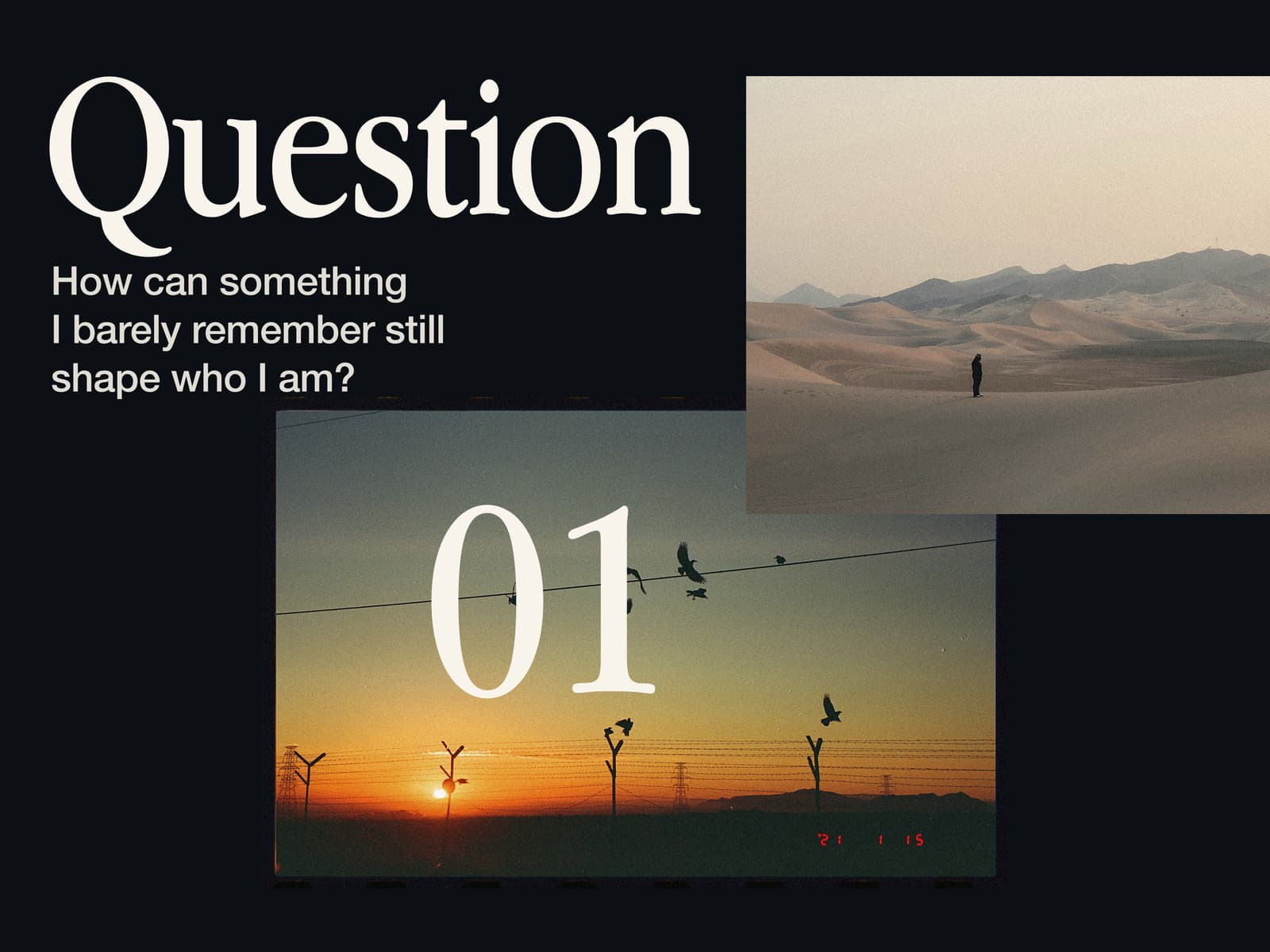
How can something I barely remember still shape who I am?
On memory, uncertainty, and the parts of the past that remain without a clear story.
Recently, I had a conversation with someone about things we both experienced in childhood.
What struck me was how little of it seemed available as a normal memory.
Some things existed only as fragments. A room. A feeling. A single moment without a beginning or an end.
Some memories felt like I was looking at them from the outside, almost as if they belonged to someone else.
Others were not really memories at all. More like the knowledge that something happened, without being able to see it, place it, or replay it.
What unsettled me most was not the missing detail.
It was what the missing detail did to my trust in myself.
Memory does not work like a video recording. It is reconstructed whenever we return to it. What we remember can be influenced by later experiences, emotions, conversations, and the person we have become since.
A memory can feel incredibly real and still be inaccurate.
But a memory being unclear does not automatically make it false either.
That is the uncomfortable part.
Clarity is not proof. But neither is the absence of clarity.
Research on autobiographical memory shows that our memories are part of how we build the story of who we are. We connect separate experiences into something that feels like a continuous life.
But what happens when parts of that story are missing?
Other research involving people with PTSD has found that some traumatic memories can be less integrated with the rest of a person's autobiographical memory. They may appear as isolated sensations, images, or moments instead of a complete story.
Still, that is not true for everyone.
Traumatic memories can be fragmented, but they can also be extremely vivid and intrusive. Sometimes they can be both.
A gap in memory is not proof that something traumatic happened.
A fragment is not a verdict.
This is where it becomes easy to create an explanation that feels right, but cannot be confirmed.
You notice a reaction in your adult life. A fear, a pattern, a way of dealing with conflict or closeness. Then you start working backwards.
Maybe I react this way because something happened.
Maybe.
There is strong evidence that difficult childhood experiences can affect emotion regulation, relationships, mental health, and personality development later in life.
But an adult pattern is not a forensic record of childhood.
You cannot look at one behaviour today and use it to prove one particular event from the past.
The pattern may be real while the explanation is still uncertain.
And uncertainty creates its own problem.
If I knew with certainty that something serious had happened, I could place it somewhere. I could decide what it meant. I could begin to understand what it changed.
I might also have to see certain people differently.
Some relationships might have to be adjusted. Some parts of my worldview might no longer hold. Some things might become impossible to excuse.
Maybe that is part of why uncertainty can also feel protective.
Not knowing delays the verdict.
It allows everything to remain where it is.
But it also means there is nothing solid to confront. Nothing clear enough to fully process. You are left trying to understand the effect without being certain of the cause.
I am not interested in forcing a memory into existence just to fill the gap.
That would only replace uncertainty with a story that might be wrong.
But dismissing the uncertainty does not feel honest either.
Maybe the most responsible place is somewhere between certainty and denial.
To take the patterns and feelings that exist today seriously, without pretending that they prove exactly what happened in the past.
To admit that memory is imperfect, while also admitting that its imperfections can have consequences.
I do not know whether every missing piece can be recovered.
Some probably cannot.
Maybe the question is not only:
How can something I barely remember still shape who I am?
Maybe it is also:
How do I learn to trust myself without turning uncertainty into fact?
Further reading
- The Neuroscience of Memory: Implications for the Courtroom, Lacy and Stark, Nature Reviews Neuroscience, 2013
- Emotion and Autobiographical Memory, Holland and Kensinger, Physics of Life Reviews, 2010
- Are Trauma Memories Disjointed from Other Autobiographical Memories in PTSD?, Kleim, Wallott and Ehlers, Behavioural and Cognitive Psychotherapy, 2008
- The Development of Autobiographical Memory, Robyn Fivush, Annual Review of Psychology, 2011
- Emotion Regulation as Mediator Between Childhood Adversity and Psychopathology, Miu et al., Clinical Psychology Review, 2022
One email when something is worth sending. Unsubscribe anytime.